Nov 28, 2025 – Prayer Focus
Friday, November 28, 2025 – The 24/7 National Strategic Prayer Call
“A CALL TO THE WALL…ONE NATION UNDER GOD”
1-712-770-4340 Code: 543555 # (Ongoing call…24 hours a day!)
We begin our hour by praising and giving thanks to God!
“Through the Lord’s mercies we are not consumed, because His compassions fail not.
They are new every morning! Great is Your faithfulness.”
Lamentations 3:22-23
We sing: The Steadfast Love of the Lord Never Ceases
The steadfast love of the Lord never ceases.
His mercies never come to an end.
They are new every morning, new every morning.
Great is Your faithfulness, O Lord.
Great is Your faithfulness!
(repeat)
~~~
For us to receive and put on the Ephesians 6 “full armor of God” as we begin each hour,
that we might be protected as we continue to “stand in the gap” for our beloved country!
Pray.
The key assignment for the 24/7 National Strategic Prayer Call is to intercede hourly
for the safety and security of our President, Donald John Trump,
and to pray for that which pertains to our nation!
We pray for his protection and ask that he be led by the Holy Spirit
so that he will discern truth and act for the good of the nation.
We bless our First Lady, Melania, their marriage and family, and cover them all with the Blood of Jesus.
Pray.
For those leaders that God has anointed, appointed, and elected,
as they take their places in the governments of each state and in our nation’s Capitol!
May they work together to clean up corruption in our government and restore our electoral system.
We also pray for the protection of members of this Administration,
especially those in the Cabinet, and law enforcement agencies, such as ICE, FBI, CBP, et al.
Pray.
For God’s blessing and intervention in the life of Joe Hoft and his family,
bringing a miraculous resolution to the issues threatening and attacking him!
Pray.
We will now spend the next 10 minutes praying for President Trump,
focusing our prayers against any demonic attacks against him.
Let him remain in good health, so he can serve his entire 4-year term as our 47th US President!
Pray.
Strategic Focus for Friday
WELCOME THE KING OF GLORY INTO THE UNITED STATES OF AMERICA
ENGAGING IN A WARFARE OF LOVE, PRAYING FOR THE SALVATION OF OUR NATION
AND THE RESTORATION OF OUR FOUNDING PRINCIPLES – PART 311
“Woe to you lawyers! For you have taken away the key of knowledge.
You did not enter in yourselves, and those who were entering in you hindered.”
Luke 11:52
REVIEW OF SCOTUS’ TARIFFS CASE – Part 1 – Chief Justice John Roberts
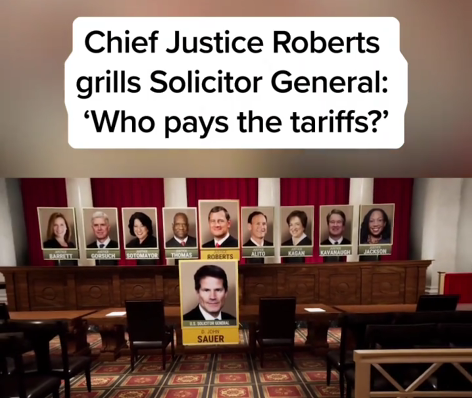
During the November 5th oral arguments in the SCOTUS case regarding President Trump’s “Liberation Day” tariffs, Chief Justice John Roberts was once again at the center of a constitutional debate. He expressed serious concern over President Trump’s broad use of the 1977 International Emergency Economic Powers Act (IEEPA), saying he had sidestepped Congress’s core Article I powers. A review of controlling precedents and the statute’s text shows that the weight of law still ultimately favors the President’s national-security and foreign-affairs discretion in a declared emergency. Today, we will review 3 of Chief Justice Roberts’ objections. Read and pray.
1st Objection: Tariffs are Article I Taxes During his questioning of Solicitor General John Sauer, Roberts directly referenced the price increases for everyday goods that occur as part of the initial economic impact of tariffs — emphasizing their effect on everyday Americans. The Chief Justice stated, “Well, who pays the tariffs? If a tariff is imposed on automobiles, who pays them? I mean, it’s been suggested that the tariffs are responsible for significant reduction in our deficit. I would say that’s raising revenue domestically [as an Article I tax].” He observed that tariffs can “feel like an Article I tax” on American consumers by raising the price of everyday goods – the initial effect of a tariff. Yet to brand tariffs as a “tax” in the constitutional sense is both imprecise and constitutionally misleading. For more than 140 years, the Supreme Court has consistently held that an exaction imposed primarily to regulate foreign commerce is not an Article I “tax”…even when it raises substantial revenue and increases consumer prices.
The Head Money Cases (1884) declared duties “a form of regulation of commerce… the fact that they also raise revenue does not make them taxes in the constitutional sense”;
Field v. Clark (1892) stated that “the authority to fix rates of duty… is not [Article I] legislative power in the constitutional sense”;
the J.W. Hampton case (1928), Chief Justice William Howard Taft wrote for a unanimous Court that a tariff “laid for the purpose of regulating commerce with foreign countries… is not a tax within the meaning of the Constitution”; Board of Trustees v. United States (1933) ruled that “the fact that the proceeds go into the Treasury does not change the character of the exaction… it is a regulation of commerce, not taxation”;
Under this unbroken, century-and-a-half series of Supreme Court rulings — from the Gilded Age to the present — the current regulatory foreign policy tariffs, whose predominant aim is to correct decades of non-reciprocal trade, protect American intellectual property and rebalance foreign commerce, are regulatory measures of international trade and national-security policy, not Article I taxes, regardless of their incidental revenue effects. According to Supreme Court precedent, the short-term consumer impact identified by the Chief Justice does not transform a foreign commerce regulatory tool into a constitutional tax. Pray.
2nd Objection: Major Questions Doctrine (MOD) The Chief Justice invoked the MQD — the judicial belief that government agencies may not exercise major authority of vast economic and political significance (highly consequential matters) unless Congress has spoken with unmistakable clarity in the operative statute (Congressional legislation). Roberts’ MQD objection seems reasonable…at first. However, the very nature of an unforeseen or unprecedented threat in foreign affairs makes it legislatively impossible for Congress to, in advance, cover every conceivable contingency with the clarity that a domestic-agency major-questions dogma might demand. That is why applying the major-questions doctrine was directed only toward domestic regulatory programs carried out by administrative agencies…never the Executive Branch spheres of authority regarding foreign policy and national security. To overgeneralize and arbitrarily impose MQD for the very first time to the Executive Branch in regards to foreign commerce would ignore both logic and precedent. Congress cannot reasonably be expected to draft an exhaustive statutory menu that textually “anticipates” every future act (intellectual-property theft, predatory trade practice, supply-chain coercion, or some other unforeseen foreign policy threat). Requiring such would leave the President powerless, in the presence of an unforeseen threat or situation, until Congress could convene, debate, and enact legislation—an obvious impossibility in a time-sensitive international crisis. For this reason, Congress deliberately chose sweeping language in IEEPA, authorizing the President, upon declaring an “unusual and extraordinary threat… to the national security, foreign policy, or economy of the United States,” to “regulate, direct and compel, nullify, void, prevent or prohibit… any acquisition, holding, withholding, use, transfer, withdrawal, transportation, importation or exportation of… any property in which any foreign country or a national thereof has any interest… by any person, or with respect to any property, subject to the jurisdiction of the United States.” Pray.
This expansive breadth of IEEPA is not an oversight. Rather, it is the considered design of a post–Watergate Congress that sought to restrain wartime excesses under the old Trading with the Enemy Act (TWEA) while still preserving the executive flexibility required for unforeseeable crises in foreign affairs. The Supreme Court has repeatedly ratified that choice.
In Dames & Moore v. Regan (1981), the Court described IEEPA’s grant as “sweeping and unqualified” and emphasized that “Congress cannot anticipate and legislate with regard to every possible action the President may find it necessary to take.”
In Zivotofsky v. Kerry (2015), the Court held that the President’s foreign-relations authority is “exclusive” and not subject to the same textual constraints that govern domestic regulation. Most importantly, when the President acts pursuant to an express statutory authorization in the foreign-affairs domain, his power operates at its constitutional maximum.
Justice Jackson’s controlling concurrence in Youngstown Sheet & Tube Co. v. Sawyer (1952) remains canonical judicial law: “When the President acts pursuant to an express or implied authorization of Congress, such as in IEEPA, his authority is at its maximum, for it includes all that he possesses in his own right plus all that Congress can delegate… [Such actions] are supported by the strongest of presumptions and the widest latitude of judicial interpretation.” This extremely magnanimous ruling pertaining to the “widest latitude of judicial interpretation” granted to the President by the Court in the Youngstown case, in regards to all Congressionally delegated authority, including foreign policy and foreign commerce, is antithetical to the extremely narrow, hyperspecific textualist demands of the major questions doctrine when overgeneralized to Executive foreign affairs. Thereby, suddenly insisting on legislative language that the Court has never required in regards to Executive foreign policy would violate all aforementioned precedents and cripple the United States’ ability to respond to emerging, agile, and unanticipated foreign policy threats. Pray.
3rd Objection: Separation of Powers Imbalance Roberts himself framed regulatory foreign policy tariffs as a highly effective non-military lever against strategic adversaries when he said, “foreign affairs is a core power of the executive…[O]ne thing is quite clear, is that the foreign-facing tariffs have in several situations been quite effective in achieving a particular objective.” Regulatory foreign policy tariffs grant the President the authority to respond decisively to nonreciprocal trade and economic or militaristic aggression without waiting for congressional gridlock. Economic coercion through foreign policy tariffs is a core non-military tool to leverage geopolitical and economic concessions, negotiations and deterrence, and Congress delegated it precisely with broad, sweeping language because novel, dynamic and time-sensitive foreign policy emergencies demand speed—Section 232 and 301 tariffs can take months or even years to process, way too long to be effective for any form of non-military deterrence or economic negotiation, while IEEPA allows immediate response. However, in spite of personally admitting the clear advantages that regulatory foreign policy tariffs provide, as a third core objection, Roberts warned that unilateral executive action bypasses Congress’s Article I purse strings, regarding taxation and commerce, risking a separation-of-powers imbalance. He stated: “the foreign commerce part [of foreign affairs] … [is] two-facing. Yes, of course, tariffs and dealings with foreign powers [are legitimate applications of Executive foreign policy], but…to have the President’s foreign affairs power trump that basic power [of taxation and commerce] for Congress seems to me, to kind of, at least neutralize between the two powers, the executive power and the legislative power.” Here, the Chief Justice is articulating concerns regarding the doctrine of separation of powers being upheld in an intersection of powers context in the sphere of regulatory foreign policy tariffs. As already decided by Supreme Court precedent, in the edge case where the constitutional powers of Article I (Congress’s powers over commerce and taxation) and Article II (the President’s foreign affairs authority) intersect, in the realm of foreign policy, the Executive Branch holds inherent, plenary (complete) power and precedence, and the Legislative Branch must defer. This deference stems from the Constitution’s structure, historical Court precedent, and the need for unified national action abroad.
Pray.
In United States v. Curtiss-Wright Export Corp. (1936), Justice Sutherland explained that Foreign-affairs power is “in origin and essential character different” from domestic power; the President is the “sole organ” of the nation abroad and “does not require as a basis for its exercise an act of Congress”. This landmark ruling established that when national security intersects with congressional commerce powers, executive discretion prevails. Similarly, Zivotofsky v. Kerry (2015), struck down a congressional statute directing the State Department to list “Israel” on passports for Americans born in Jerusalem, affirming the President’s exclusive recognition power under Article II, (despite direct conflict with Article I’s legislative authority.) Justice Kennedy’s majority opinion emphasized that “the President alone has the power to speak or listen as a representative of the nation“ rendering congressional mandates on diplomatic recognition unconstitutional. The Court relied on historical practice to conclude that such executive prerogative “subsumes” legislative efforts, ensuring a “single-voiced statement” in foreign relations—a direct rebuke toward attempts to subordinate the President under Congress at an Article I-Article II intersection of powers in the sphere of foreign policy. These cases collectively demonstrate that, at an Article I-II intersection of powers in regards to foreign affairs, the Supreme Court has consistently deferred to the Executive Branch over the Legislative Branch, thereby precedentially informing congressional grants like IEEPA as activations of inherent presidential power in the plenary realm of Executive foreign policy. Chief Justice Roberts’ concerns run counter to a settled body of precedent that prioritizes the Nation’s need for an expedient, unified foreign-policy response over legislative control that would subject the United States to congressional gridlock and leave it vulnerable to foreign policy threats, including economic coercion and aggression by any and all foreign adversaries.
Pray.
We pray:
That the body of settled law (previous rulings that have been made in support of President Trump’s position
in this case) will be upheld, ensuring him a final victory. Pray.
That Chief Justice Roberts will review his previous decisions and have his “concerns” alleviated so that he rules in favor of President Trump. Pray.
That the people of our nation will stand alongside President Trump, and remain engaged in this BATTLE TO SAVE AMERICA until VICTORY is won! Pray.
Protect, strengthen, and cover our 24/7 family in the Blood of Jesus against all warfare and witchcraft. Bring in new intercessors, in particular, Godly men and those of the next generation who are called to this assignment with us, to pray for our President and our beloved nation! Prepare us for our NEXT STEPS in this Battle to Save America! Pray.
(Resource: SCOTUS Website)
~~~
Listen to the song ahead of time, then either sing or pray it!
~~~
HINENI, ADONAI! HERE I AM, LORD!
ENGAGING IN A WARFARE OF LOVE! THE BATTLE OF THE BRIDE!
KADIMA! ONWARD…FORWARD!
“LAYNA!” LIGHT AND TRUTH!
BE STRONG…COURAGEOUS…BRAVE!
UNASHAMED OF THE GOSPEL OF CHRIST!
GOD’S CHAMPIONS FOR LIFE!
MARANATHA! COME, LORD JESUS!
BE READY! REVIVAL IS COMING!
ONE NATION UNDER GOD, INDIVISIBLE, WITH LIBERTY AND JUSTICE FOR ALL!
ONE NEW MAN!
VICTORY!
STANDING IN THE GAP!
REVIVAL – from Heart to heart!
PARENTAL CARE and CHRISTIAN LOVE for ALL CHILDREN!
UNITE US! FOR THE KING AND HIS KINGDOM, FROM GENERATION TO GENERATION!
~~~
SIGN UP TO RECEIVE THE DAILY FOCUSES THROUGH OUR 24/7 NSPC GOOGLE GROUP
Send your name, state, cell, and email address to us at: WTKOG13@gmail.com
To print, use the attached PDF file
https://acrobat.adobe.com/id/urn:aaid:sc:VA6C2:d49690ca-c52f-4463-8446-959a36b80b5c